Curriculum

At St. Joseph’s, the curriculum is deeply rooted in our mission statement, ‘Growing in Love, in the Spirit of Christ, for the benefit of all’. This aspiration embodies our commitment to creating a nurturing and inclusive environment, where every pupil can flourish academically, socially, and spiritually.

Our knowledge-rich curriculum is designed to reflect the Gospel Values and the Catholic Social Teaching principles, ensuring that it meets the diverse needs of our students. We strive to provide pupils with a breadth of experiences and opportunities that not only support their individual learning journeys but also help them develop into compassionate and responsible members of society.

On each class page, you will discover up-to-date information concerning your child’s learning across all subjects. Essential details, including homework, are readily accessible to parents and guardians.

Below, you will find comprehensive information on each subject area. This transparency is aimed at fostering a collaborative partnership between school and home, enabling us to work together in support of your child’s education. We invite you to explore these resources and engage actively in your child’s learning experience.

Curriculum Subjects

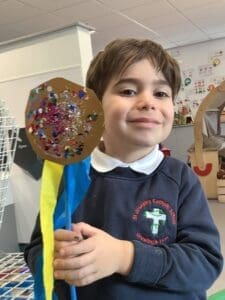
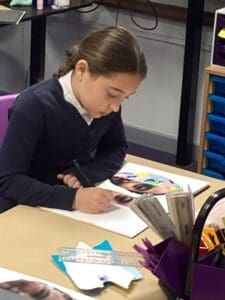
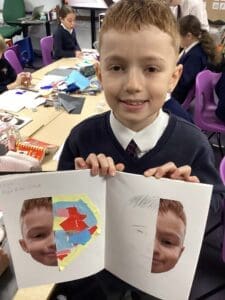
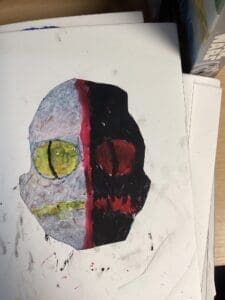
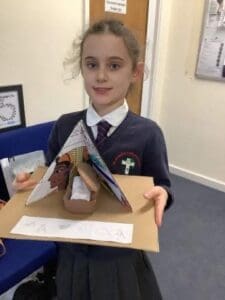
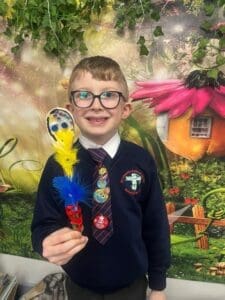
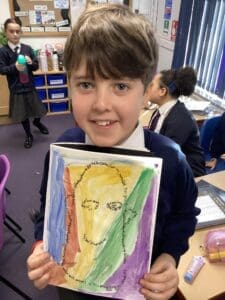
At St Joseph’s, we value the importance of Art and Design. It is our children’s entitlement to be able to share and express their individual creativity, independence, resilience, and self-reflection. It is our intent to provide all children with the fundamental skills, techniques and knowledge needed to independently create their own unique
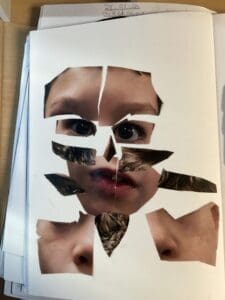
drawings, paintings, sculptures, and crafts. We want the children to have a natural sense of wonder and curiosity when studying a wide variety of artwork. We empower children to discover great artists that will enable them to explore their own and other’s cultural heritages.
We give the children the time and space to explore new themes, new sensations, and ways to be creative without the need to be perfect. At St Joseph’s, we believe that the process takes precedence over the product. We want our children to see the enjoyment and satisfaction in the process of producing art. It is through the children’s personalised experience of art at St Josephs, that we enable the children to feel safe, secure, and happy, to produce their most creative work.

Implementation:
The teaching and implementation of the Art and Design Curriculum at St Joseph’s Primary School begins in Early years, through developmental matters, and the National Curriculum in KS1 and KS2. All year groups are linked to topics to ensure a well-structured approach to this
creative subject. We teach a skills-based art curriculum, which shows a clear progression within school.  Art  is supported through the studying of key artists (which can be found in our Long-Term Planning) and the development of a knowledge of their work through research.
In EYFS the children have daily access to a variety of media and materials which they can explore to produce their own creative work. Provision is carefully planned to suit the interests of the children, whilst developing the necessary skills they are working on. Through
on-going observations of the children, the adults have an in-depth knowledge about each child’s development. This ensures that the adults facilitating learning know each child’s next steps and can give the children the learning opportunity and experience they need to
develop their skills in art. We place high importance on EYFS, as we know this provides the fundamental base for all learning. It is then in KS1, where the fundamental skills are developed and we look for any gaps in the children’s skills, so that we can close any gaps at
an earlier stage. By upper KS2, we aim for the children to use all the skills and knowledge that has been built upon year after year, to apply it to a variety of media and materials.
KS1 and KS2 both use sketchbooks to document their art learning journey, they are given time with their sketch books to practise new skills before applying them to create a new piece of artwork.
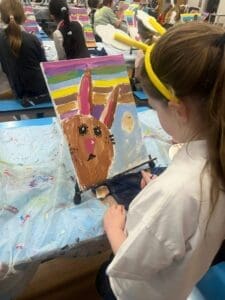
As well as this, art is promoted throughout our school through a variety of platforms. We hold after school art clubs, which are very popular, and art clubs where the children produce seasonal canvas pictures, such as Easter, Christmas etc.

Impact
By the end of each Key Stage, all children can apply and understand the skills, knowledge, and processes they have been taught so that they are proficient in drawing, painting, sculpture and other art, craft, and design techniques.  Teachers use summative assessments to record the progress and attainment against the National Curriculum expectations. This information is used to inform future lessons; ensuring children are always supported and challenged appropriately. Most importantly, children will leave St Joseph’s  knowing that it is okay to make mistakes along
their journey, they will think for themselves and be critical about their own and other’s work- knowing how they can improve it or knowing when to stop if they are satisfied with their creative work. This is all implemented through our evaluation process.

Art And Design Intent DocumentArt Coverage Overview
All pupils at St. Joseph’s have the right to have rich, deep learning experiences that balance all the aspects of computing. The computing curriculum is split into three strands:

  • Computer Science (programming or coding, and problem solving)
  • Information Technology (using spreadsheets, creating presentations and manipulating graphics)
  • Digital Literacy (encompassing e-safety and teaching pupils how to select the most appropriate digital content).

With technology playing such a significant role in society today, we believe ‘computational thinking’ and ‘creativity’ are skills children must be taught if they are able to participate effectively and safely in this digital world.

We use 2BeSafe on Purple Mash to deliver our online safety provision. This has been split into the core areas of online safety:

  • Self-image and identity
  • Online relationships
  • Online reputation
  • Online bullying
  • Managing online information
  • Health, well-being and lifestyle
  • Privacy and security
  • Copyright and ownership

Computing Intent Document

Computing Overview 2026

As part of Safer Internet Day 2026, Mansfield Town Community Trust delivered a whole school assembly based on this year’s theme: Smart tech, safe choices – exploring the safe and responsible use of AI.

At St Joseph’s, it is our intent that children grow up being creative and being inspired by design and technology, and understand the connections between the skills they are developing and the real world.
Sound knowledge of design and technology, and consistently high Quality First Teaching is key to delivering a quality mastery of the design and technology curriculum.
We aim to provide our children with a wide range of opportunities to take risks, innovate and to understand the value and impact technology has on daily life and the wider world. We want them to
be equipped with the skills they require to thrive in a rapidly evolving world. We begin by exploring the technology around us through practical investigation. Moving further up the school, activities are
creative and practical with the aim to develop the foundation skills required to innovate, design, create and evaluate. Pupils then develop the skills they have acquired; designing and making a product for a purpose . They apply research they have carried out and use their
prior knowledge to safely use a wide range of tools to complete their design. We want the children to become confident with the creativity process where they can design and use technology, with an ability to apply their skills to a wide range of situations and purposes. They are
given the support, skills and encouragement in order to enable to enjoy their learning. We also encourage them to develop inquisitive minds and self-belief so they want to push themselves to learn more. Design and Technology is an inspiring, rigorous and practical subject which
prepares all young people to live and work in the designed and made world.

Implementation
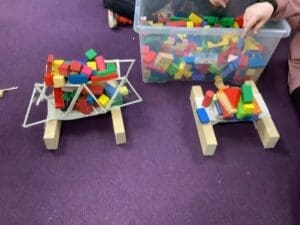
To ensure high standards of teaching and learning in art and design, we use the Kapow which allows clear progression through the school. D&T is taught through a cross-curricular approach linking topic work and themes in each Year group as much as possible.
Where possible the children explore different techniques and methods, try them out and then have the opportunity to explore adjustments or say how they would improve their designs through their evaluations.
At times they may be asked to take part in collaborative learning where children may be asked to work as part of a team to work on a product.
The children learn to support and help one another towards a challenging, yet rewarding goal. As the children progress up the school they will have an increasing awareness of the health and
safety aspects of D&T and be able to apply these within school and their own lives.

Impact
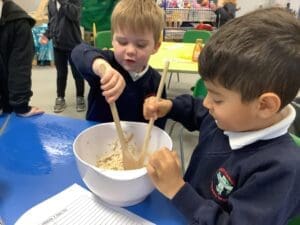
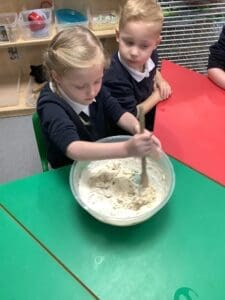
The children will have clear enjoyment and confidence in design and technology that they will then apply to other areas of the curriculum. Whole school events like ‘Homework’ often encompass D&T and the children enjoy sharing their efforts together and learning from each other.
D&T encompasses many cross-curricular links and children are able to apply what they learn in other areas of the curriculum and in opportunities out of school and within their lives. Staff use summative assessments as children progress through the skills, to measure the impact of our curriculum through reflecting on standards achieved against the planned outcomes, pupil discussions about their learning and through collaboration of teachers and the subject leader through monitoring, pupil voice and lesson observations.

DT Coverage OverviewDesign And Technology Intent

We believe that Literacy is an essential part of children’s learning. It enables children to be able to communicate effectively with others for a variety of purposes and to examine their own and others’ experiences, feelings and ideas, giving these orders and meaning.

Through our Writing curriculum, we intend to provide children with the chance to communicate effectively and creatively, giving them the opportunity to write for a purpose and an audience. Through doing this, we aim to ensure that children enjoy and appreciate literature, and its rich variety and forms.

Writing Intent 2025 2026

Geography plays an important role in helping our children understand the world God has created and their place within it. Our geography curriculum is designed to spark curiosity and a lifelong interest in the world and its people. We encourage children to ask questions, explore new places and develop a sense of wonder about both the local area and the wider world.

Through engaging and practical lessons, pupils learn about different countries, cultures, landscapes and environments, as well as the physical and human processes that shape our planet. As they move through the school, children build a deeper understanding of how people and the environment interact, helping them to develop a sense of responsibility and care for the world around them.

At St Joseph’s, geography supports our pupils in becoming informed, thoughtful and respectful global citizens, rooted in their local community and guided by our Catholic values.

Geography Concept Theme Overview

Geography Curriculum Intent 25 26

At St Joseph’s Catholic Primary School, we believe that learning about the past helps children better understand themselves and the world they live in today. Our history curriculum is designed to give pupils a clear and engaging understanding of Britain’s history, as well as that of the wider world, helping them to see how the past has shaped the present.

We aim to spark children’s curiosity and encourage them to ask questions about how people lived, the choices they made and the challenges they faced. Through storytelling, discussion and exploration of historical sources, pupils learn to think carefully, weigh evidence and develop their own ideas and judgements.

History also helps our children to appreciate the diversity of societies and cultures, understand change over time and develop respect for others. By learning about different people, events and periods in history, pupils build a strong sense of identity and are supported in becoming thoughtful, informed and reflective learners, guided by our Catholic values.

At St. Joseph’s the mathematical curriculum is delivered through a concrete, pictorial, abstract approach. The curriculum is delivered using the teaching for mastery in mathematics, in collaboration with the East Midlands Maths Hub, alongside White Rose Maths.

The curriculum in F1 is taught through daily dedicated sessions. These sessions are carefully planned and use concrete resources. Sessions build on prior learning and real-life experiences. We use key rhymes, closely linked with each core focus, which change every two weeks. In F2, Mastering Number at EYFS is used alongside development matters. Throughout EYFS, children ae exposed to new mathematical vocabulary, such as subitising, counting ordinally and cardinally, composition, numerals, comparison, number and quantity.

In KS1 we use Mastering Number, which is a structured approach, building a strong foundation in number sense and mathematical language. These are short 15 minute daily sessions. These short sessions are taught alongside the maths curriculum.

A range of strategies are used to ensure that all pupils can access mathematics, giving them opportunities to draw on prior knowledge and consolidate their learning.
We support learning through:

  • Small steps progression
  • Recall and Retrieve
  • The Five Big Ideas of Mastery
  • CPA approach
  • Use of manipulatives
  • Steps to success
  • Modelling – I do, We do, You do
  • Mathematical vocabulary
  • Opportunities for all abilities to access a range of reasoning and problem solving
  • Opportunities to explore learning at a ‘greater depth’.
  • Scaffolding

Maths Progression

At Key Stage 2, our pupils learn French through the Kapow Primary French scheme, which provides a fun, structured, and engaging approach to language learning. The scheme is designed to build children’s confidence and enthusiasm for learning a new language, helping them to develop key communication skills that will support their future language learning at secondary school and beyond.

Through Kapow’s carefully sequenced lessons, pupils explore French vocabulary, pronunciation, and grammar in meaningful contexts. Each unit includes interactive songs, games, stories, and speaking activities, ensuring that learning is both enjoyable and memorable. Pupils are encouraged to listen, speak, read, and write in French, developing their ability to express ideas and hold simple conversations.

Lessons also introduce children to the culture and traditions of French-speaking countries, helping them appreciate the wider world and make cross-curricular links with subjects such as Geography, Art, and Music.

By the end of Key Stage 2, pupils will have developed:

  • A growing vocabulary and understanding of basic French grammar

  • The confidence to take part in short spoken exchanges

  • The ability to read and write simple sentences in French

  • An awareness and appreciation of Francophone culture

Our aim is for every child to leave Key Stage 2 feeling curious, confident, and inspired to continue learning languages in the future.

Standard French LongTermPlan 15.04.25French Intent Document 2025

At St. Joseph’s, Music is used to inspire and motivate children. It allows our children to express their own thoughts and feelings. Our children learn to recognise that Music reflects the culture and society we live in. Therefore, Music provides unique opportunities for children to better understand the world they live in.

Through the Our Lady of Lourdes Music Providers, opportunities are made for all children to create, play, perform and enjoy music. They develop the skills to appreciate a wide variety of musical forms, and to begin to make judgments about the quality of music.

The school believes that physical education develops pupils’ physical competence and confidence, and their ability to use these to perform a range of activities. We believe that P.E. provides children with opportunities to be; creative, co-operative and competitive, and to engage in challenging and adventurous activities.

‘Physical Education inspires all pupils to succeed and excel in competitive sport and other physically-demanding activities. Opportunities to compete in sport and other activities build character and help to embed values such as fairness and respect.’ (The National Curriculum 2013.)

Through our teaching, we hope to develop the idea that our bodies are gifts from God, and should be cared for and respected.

At Saint Joseph’s we promote fair play and respect and hope to nurture a love and enjoyment of sport through PE.

Using thePEHub as the basis for planning, pupils in Key Stage One are taught skills in; gymnastics and dance as well as the fundamentals to; running, jumping, catching, throwing, hitting, attacking, defending and shooting. In Key Stage Two, these skills are further developed through a variety of sports including; football, tennis, athletics, cricket, netball and rounders. All children have the opportunity to access Outdoor Adventurous Activity for half a term each year through the Forest Schools provision.

The introduction of OPAL play has meant that children are more active over a break and lunch time and the after school clubs provided ensure that children are receiving the required amount of physical activity in line with the national guidance.

Mansfield Town Football

As part of our work with Mansfield Town Community Trust, every child across school will take part in a PE unit delivered by specialist coaches.

Premier Education

As part of our work with the Premier Education Wow Active program, pupils have had the opportunity to take part in enrichment days. Recently, all children across school had the opportunity to take part in a curling lesson.

Any teaching about love and sexual relationships in a Catholic school must be rooted in the Catholic Church’s teaching about what it is to be truly human in Christ, what it means to live well in relationship with others and be presented within a positive framework of Christian virtue. For this reason, we, as a Catholic schools speak about Relationship and Sex Education (RSE) rather than Sex and Relationship Education (SRE), since this emphasises the importance of healthy relationships to human well-being, as the core learning within an RSE curriculum.

Online Parent Portal

If you wish to look further at the RSHE currciulum taught in school, please access our online parent portal with Ten Ten.

Life to the Full Plus Primary

Here you will able to see in more detail the content covered over the course of the different years.

Username: st-josephs-ng22

Password: apple-tree

At Joseph’s School we follow  the National Curriculum and the guidelines of White Rose Science. The Science curriculum aims to help children develop foundational scientific skills and knowledge which is built on each year.
Disciplinary knowledge includes: asking questions, making observations, take measurements, gathering and classifying data, presenting and finding information and drawing conclusions.
Subject knowledge is built upon each year and a break down of the topics are in the whole school science overview below.
We celebrated British Science Week in March. The theme was ‘Curiosity’ and we practiced our questioning skills through investigations.

Science Curriculum And Disciplinary Knowledge Intent

Updated Whole School Science Overview

Phonics and Reading

In EYFS and Key Stage 1, we implement the Little Wandle phonics scheme, while Key Stage 2 students needing additional support engage with the Little Wandle catch-up programme.

Phonics Intent Statement
Here at St Josephs,  we use Little Wandle Letters and
Sounds Revised, which is a DFE validated phonics programme.
The programme is a systematic, synthetic approach to teaching
phonics, with clear expectations that are laid out term by term
from Reception to Year 2. Integrated into the programme are
high quality reading books published by Harper Collins that match
to each grapheme the children learn, this ensures that children
apply their phonetic knowledge in context through writing and
the use of high-quality reading texts. Embedded into the
programme are 3 and 6-weekly assessment tasks, which allow teachers
to identify any children that may need extra support, and never fall behind.
Phonics is taught daily from EYFS,  Years 1 and 2 (moving to spelling in Year2 for those that have secured the phonetic code).  Children work in fluid groups on aphase/grapheme that is matched to their current need. All teachers and support staff have received intense training and are experts at delivering high quality phonics sessions.
Within F1 (nursery), children work on Phase 1 of Letters and Sounds,
where the focus is centred upon developing children’s speaking
and listening skills, laying the foundations for the phonic work they
will undertake as they begin phase 2 in F2 (Reception).

Foundations For Phonics Planning Overview June 24 (1)Programme Overview Reception And Year 11de8f8d17d6a3250ad54799e5b73b356

At St Joseph’s, we believe that all children can become fluent, confident readers and writers. Reading is at the heart of our curriculum and underpins everything we do.
Phonics and Early Reading
We teach reading through Little Wandle Letters and Sounds Revised, a systematic and synthetic phonics programme. Phonics teaching begins in Foundation 1 and follows a clear progression, ensuring that children steadily build their knowledge of the alphabetic code. This enables them to read and spell with confidence as they move through the school.
Through this approach, children learn to tackle unfamiliar words independently. Phonics is not taught in isolation; we actively model the use of phonics during shared reading and writing across the curriculum, helping children apply their skills in meaningful contexts.
We place a strong emphasis on spoken language, recognising that speaking and listening skills are essential foundations for successful reading and writing in all subjects.
The Power of Reading.

We believe that reading supports children’s cultural, emotional, intellectual, social and spiritual development. Through reading, pupils gain knowledge, deepen their understanding of the world and build upon what they already know.
Reading for Pleasure
Reading for pleasure is a core part of life at St Joseph’s, and we are committed to developing a strong Reading for Pleasure culture across the school. We believe that regular exposure to a wide range of high-quality texts helps children become lifelong readers and has a positive impact on their future learning and life chances. All classrooms have an inviting reading area designed to inspire a love of books. These spaces promote reading through book displays, class book recommendations,
topic-related texts and author spotlights. Each year, classes are introduced to a range of quality authors and texts that are current, engaging and relevant.
Reading Aloud
Teachers regularly read aloud to pupils because research shows that children who are read to often achieve better outcomes academically and socially. Reading aloud sessions are interactive and enjoyable, with teachers modelling enthusiasm for books and encouraging discussion through thoughtful questioning. This supports children’s comprehension and enjoyment of stories. We carefully select texts that both reflect our children and local community and open windows to other cultures and experiences, helping pupils to develop empathy, curiosity and a broader understanding of the world.
At St Joseph’s, we aim to nurture confident readers who love books, enjoy reading, and are prepared for the next stage of their learning journey.

Reading Intent.

Oracy is the ability to express ideas clearly, confidently and respectfully through spoken language. In St Joseph’s, oracy is a vital part of children’s learning and development. It helps pupils to articulate their thinking, ask questions, listen carefully to others and engage in meaningful discussion.

Through activities such as talk partners, class discussions, storytelling, presentations and debates, children learn how to use their voice effectively, build vocabulary and develop strong listening skills. Oracy also supports learning across the curriculum by helping pupils to deepen understanding, solve problems collaboratively and reflect on their ideas.

By prioritising oracy, it empowers children to become confident communicators who can share their thoughts, value different perspectives and participate actively in school life and beyond.

Oracy Intent.